Why destroying silos doesn't fix the problem
There's a phrase that appears in almost every digital transformation pitch deck: "break down the data silos."
It sounds compelling. Silos are bad. Integration is good. Therefore, we must destroy the silos and build something unified in their place. Simple logic.
Except it doesn't work. Or rather, it works temporarily - until the silos grow back. Because silos aren't the disease. They're the symptom of something else entirely. And treating symptoms while ignoring causes is expensive medicine that never quite cures the patient.
How Silos Actually Form
Here's a story that plays out in almost every organisation above a certain size:
Finance Team
Needs to track project profitability. Asks IT for a solution. IT says it's on the roadmap for Q3 next year. Finance can't wait - they're haemorrhaging money on projects they can't properly cost. Someone builds a spreadsheet. Then a more sophisticated spreadsheet. Then they buy a departmental tool.
Operations
Has the same experience with workforce scheduling. The central system doesn't handle their specific needs, so they implement their own solution.
Sales
Builds their own lead tracking system because the corporate CRM doesn't handle their specific workflow.
HR
Implements a standalone learning management system because the central platform is too rigid.
None of these decisions were wrong. They were rational responses to real constraints. Central IT couldn't move fast enough. The enterprise systems were too generic. The business had legitimate needs that weren't being met.
The silos didn't form because people are stupid or uncooperative. They formed because departments were solving genuine problems with the tools available to them. Those "shadow IT" systems everyone complains about? They're evidence of initiative, not incompetence.
The Politics Nobody Talks About
There's another dimension that rarely makes it into the transformation business case: silos often represent power.
The department that controls its own data has autonomy. It can move at its own pace, make its own decisions, and isn't dependent on central functions that have competing priorities. That spreadsheet the finance director guards so carefully isn't just a data store - it's sovereignty.
The Unspoken Truth
When you propose "breaking down silos," you're not just proposing a technical change. You're proposing a redistribution of power. And people who currently hold power tend to resist having it redistributed, no matter how compelling the efficiency arguments.
This is why so many integration projects face mysterious resistance that can't quite be articulated. The stated objections are about data quality or system compatibility. The real objections are about control, autonomy, and whose priorities get served.
The Transformation Trap
So what happens when an organisation decides to "fix" its silo problem?
Typically, a large consulting firm is engaged. They conduct an extensive discovery phase, documenting all the disparate systems. They produce a compelling vision of a unified future state - clean architecture diagrams, seamless data flows, a single source of truth.
Then comes the implementation. Eighteen months. Twenty-four months. Sometimes longer. Millions of pounds. Extensive change management. Training programmes. Data migration projects.
And at the end? Sometimes it works. But often - more often than anyone likes to admit - you end up with a shiny new enterprise platform that doesn't quite do what the old systems did. The edge cases that the departmental systems handled? The new platform doesn't support them. The specific workflows that made people productive? They've been "standardised" into something less useful.
So what happens? People build workarounds. They create spreadsheets to handle what the new system can't. They implement departmental tools to fill the gaps. The silos grow back.
Yet somehow, the answer to a failed transformation is usually... another transformation. A different consulting firm. A different enterprise platform. The same fundamental approach.
Einstein's definition of insanity comes to mind.
The uncomfortable truth is that the transformation model itself is flawed. It assumes that complex, organically grown systems can be replaced with designed, unified systems - and that the designed systems will be better. But designed systems are built on assumptions about how work happens. Organic systems evolved based on how work actually happens. There's a difference.
What If We Asked a Different Question?
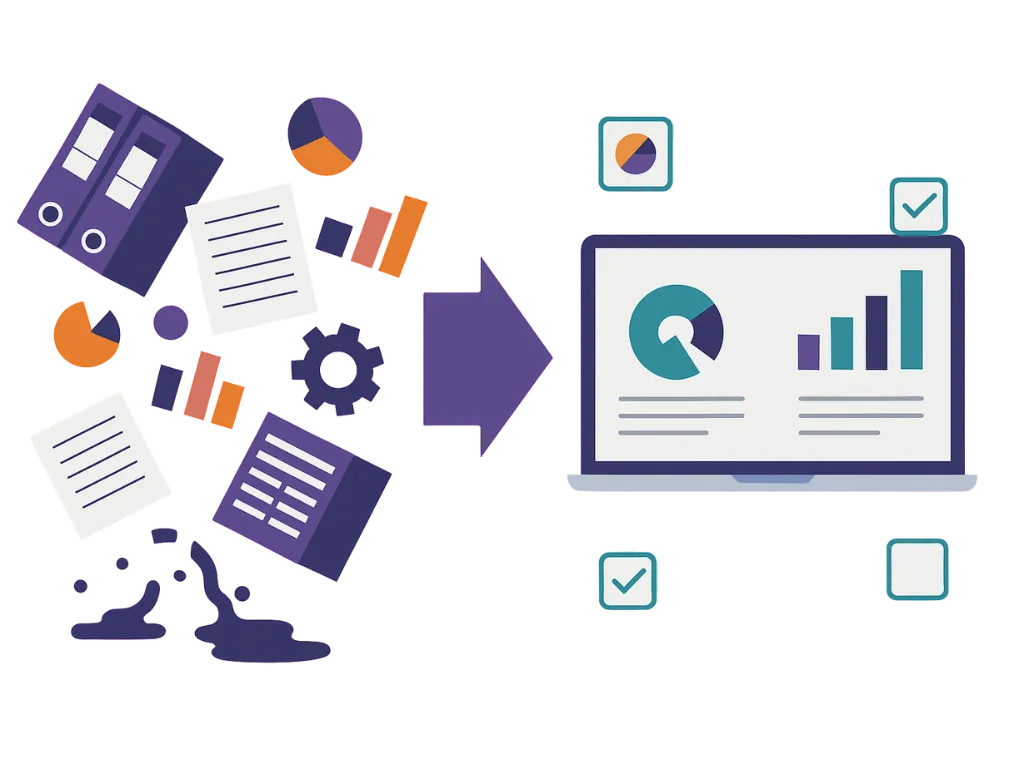
Instead of asking "how do we eliminate silos?" - what if we asked "how do we make silos work together?"
This is a fundamentally different approach. It accepts that silos exist for reasons. It acknowledges that departments have legitimate needs for autonomy and control. It recognises that organic systems contain embedded knowledge that's valuable, even if it's not pretty.
The goal shifts from destruction to connection. Not "rip and replace" but "integrate and enhance." Keep what works. Connect what needs connecting. Add visibility without removing autonomy.
Faster
Connecting existing systems takes weeks or months, not years. You're not rebuilding everything from scratch.
Lower Risk
If a connection doesn't work as expected, you haven't destroyed anything. The underlying systems still function.
Respects Reality
Departments keep their tools, autonomy, and embedded knowledge. What changes is that data can flow.
More Honest
The problem was never that silos existed. The problem was that data couldn't flow. Solve the flow problem and the silo problem dissolves.
The Integration Layer Mindset
Think of it as building an integration layer rather than a replacement platform.
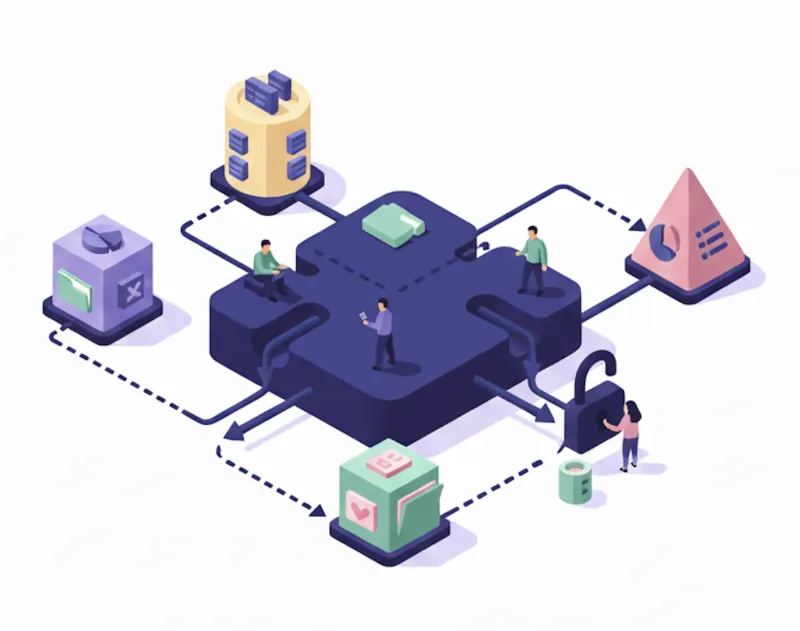
The integration layer sits above your existing systems. It connects them, translates between them, and provides a unified view without requiring unified systems underneath. Each department keeps its tools. Each system keeps doing what it does well. But data moves, insights aggregate, and the organisation can finally see across boundaries.
How the Integration Layer Works
This isn't a new idea. It's how the most resilient systems in the world are built. The internet doesn't require every computer to run the same operating system - it provides protocols that let different systems communicate. Your body doesn't have one unified organ - it has specialised organs connected by circulatory and nervous systems.
The integration layer mindset accepts heterogeneity as a feature, not a bug. It builds connection capacity rather than enforcing uniformity. It's pragmatic rather than idealistic.
What This Looks Like in Practice
Rip and Replace
- Two years implementation
- Several million pounds
- Extensive change management
- Loses embedded knowledge
- 60-70% failure rate
Connect and Enhance
- Live in weeks or months
- Fraction of the cost
- Minimal disruption
- Preserves what works
- Iterate and improve safely
The finance team keeps their project costing tool - but now it can pull resource data from HR and billing data from the CRM automatically. Operations keeps their scheduling system - but now it's informed by real-time project status from the ERP. Sales keeps their lead tracking - but now customer history is enriched with support ticket data and billing information.
Each system does what it's good at. Data flows where it needs to flow. The organisation gets the visibility it needs without the disruption of wholesale replacement.
The silos remain, technically. But they're connected silos. Permeable silos. Silos that share rather than hoard.
The Harder Conversation
None of this is purely technical, of course. The politics don't disappear just because you change the approach.
But the conversation changes.
"We need to replace your system with our enterprise platform"
Implies what you've built isn't good enough. Promises disruption and loss of control.
"We want to connect your system to others so everyone benefits"
Validates what exists. Promises enhancement rather than replacement.
You're still dealing with organisational dynamics. You're still navigating competing interests and historical tensions. But you're doing it from a position of "yes, and" rather than "no, but." That matters.
The Entropy Reality
Here's a final truth that transformation projects rarely acknowledge: systems drift.
Requirements change. Business models evolve. Markets shift. What was perfectly designed for 2024 won't be perfectly designed for 2027. This isn't failure - it's the natural evolution of any living organisation.
Monolithic systems handle this badly. When everything is tightly coupled, every change risks breaking something else. Evolution becomes expensive and scary, so it doesn't happen. The system becomes increasingly misaligned with reality until another transformation is needed.
Connected systems handle this better. When systems are loosely coupled through an integration layer, each one can evolve independently. The finance tool can be upgraded without touching the CRM. The HR system can be replaced without disrupting operations. Evolution happens continuously at the component level rather than catastrophically at the enterprise level.
The integration layer absorbs change. It's the interface that remains stable while the systems behind it evolve. It's how you pay the entropy tax continuously rather than in terrifying lump sums.
A Different Way Forward
If your organisation is struggling with data silos, you have a choice.
You can launch another transformation programme. Another multi-year project. Another attempt to boil the ocean and build something unified and clean. Maybe this time it will work. The statistics aren't encouraging, but maybe your situation is different.
Or you can accept reality. Accept that silos formed for reasons. Accept that those reasons haven't gone away. Accept that your organic, messy systems contain embedded value that deserves respect. And focus on connection rather than destruction.
At Xerini, this is the approach we've taken with clients across construction, infrastructure, financial services, and professional services. Our platform, Xefr, is built specifically for this kind of integration - connecting disparate data sources without requiring you to replace what works. We've found that organisations can move from fragmented to connected in weeks rather than years, at a fraction of the cost of traditional transformation.
But whether you work with us or not, the principle holds: stop fighting your silos and start connecting them. Treat the disease, not the symptom. Build bridges, not demolition projects.
Your messy systems grew organically because they solved real problems. That history has value. The goal isn't to erase it - it's to make it work together.
Xerini helps organisations connect their data without the pain of transformation programmes. If you're tired of integration projects that promise everything and deliver PowerPoints, we should talk.