If you watched the latest series of Clarkson's Farm, you will remember the usual mix of broken machinery, bad weather and arguments about money. However, the part that stayed with me was more subtle. Jeremy and Kaleb went to the Netherlands to see how farmers there get more out of the same ground, and came home talking about soil maps and seed rates rather than horsepower and Lamborghini tractors. The idea behind that trip deserves more attention, because it is one of the clearest examples that I've seen in a while of using data to do more with less.
The most data-driven farm you have never heard of
The farmer they were there to learn from is Jacob van den Borne, who grows potatoes near Reusel on the Dutch side of the Belgian border. He is sometimes called the pope of precision farming, which sounds grand until you look at what he has done with the numbers. When he took over the family farm, yields sat at around 45 to 46 tonnes per hectare. They now run at 53 to 54. That is roughly double the global average for potatoes, and he aims for another one per cent gain every year. He uses about twenty per cent less water doing it. None of that came from more land or kinder weather, rather it came from understanding his fields in far more detail than most farmers ever bother to.
None of that came from more land or kinder weather. It came from understanding his fields in far more detail than most farmers ever bother to.
What precision farming actually means
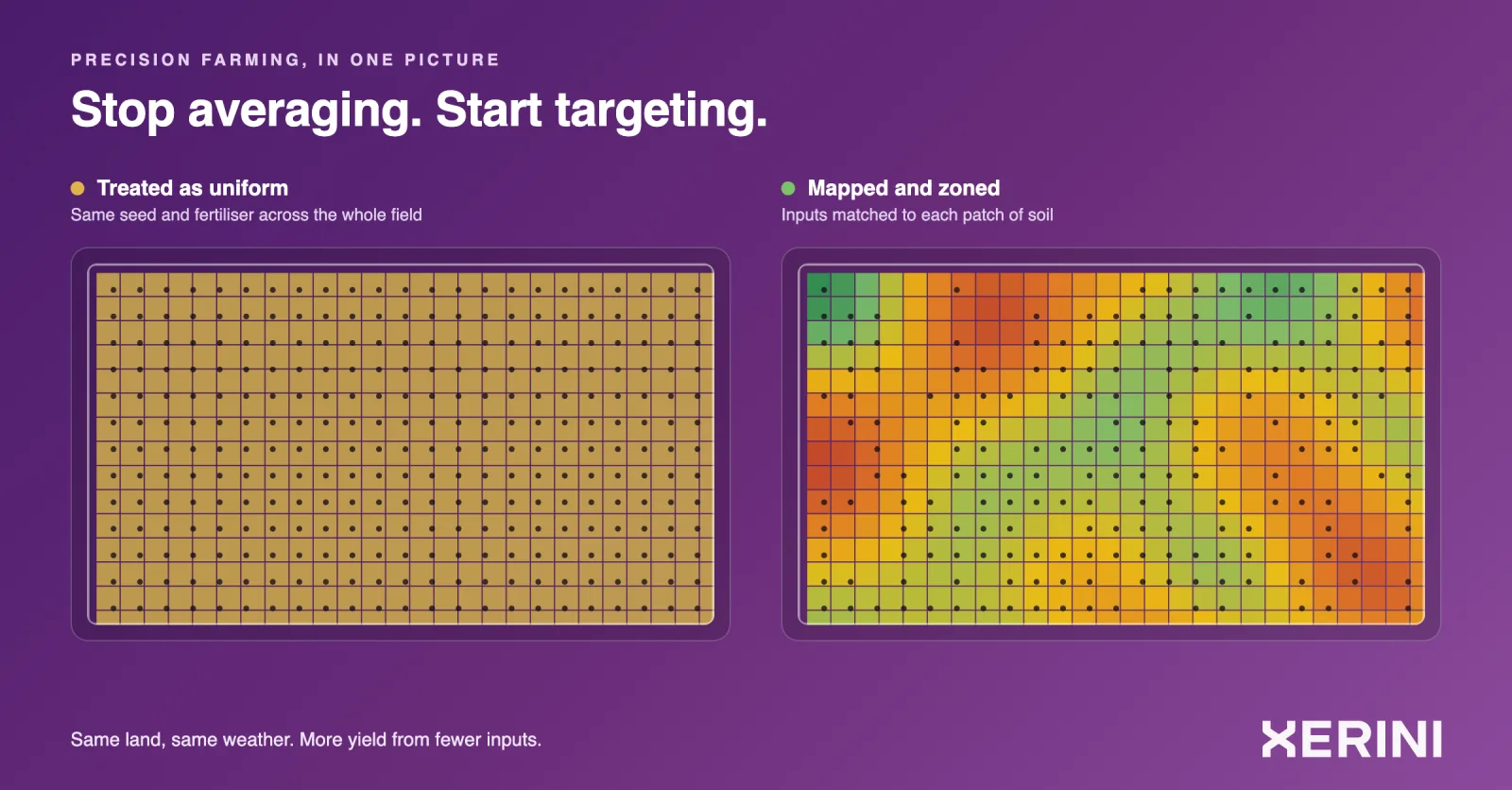
The method is less exotic than it sounds. Most fields are worked as though they were uniform; the same seed rate, the same fertiliser, spread evenly from one hedge to the other. They are not uniform. Soil changes across a single field, sometimes within a few metres, and those differences decide what grows well and what struggles.
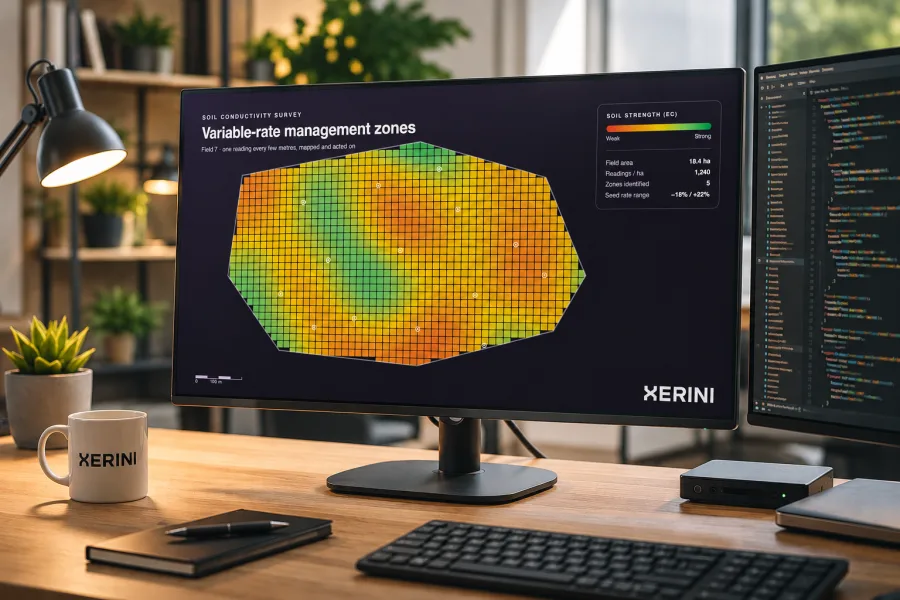
Precision farming starts by measuring that variation. A scanner towed behind a tractor reads the electrical conductivity of the soil, which reveals its texture, organic matter, moisture and nutrients. The readings become a map. Drones and satellite imagery add a view from above, picking up how green and healthy the crop is across the field. Sensors in the ground track moisture and temperature. The harvester weighs the crop as it lifts it, so every patch of ground reports back exactly what it produced.
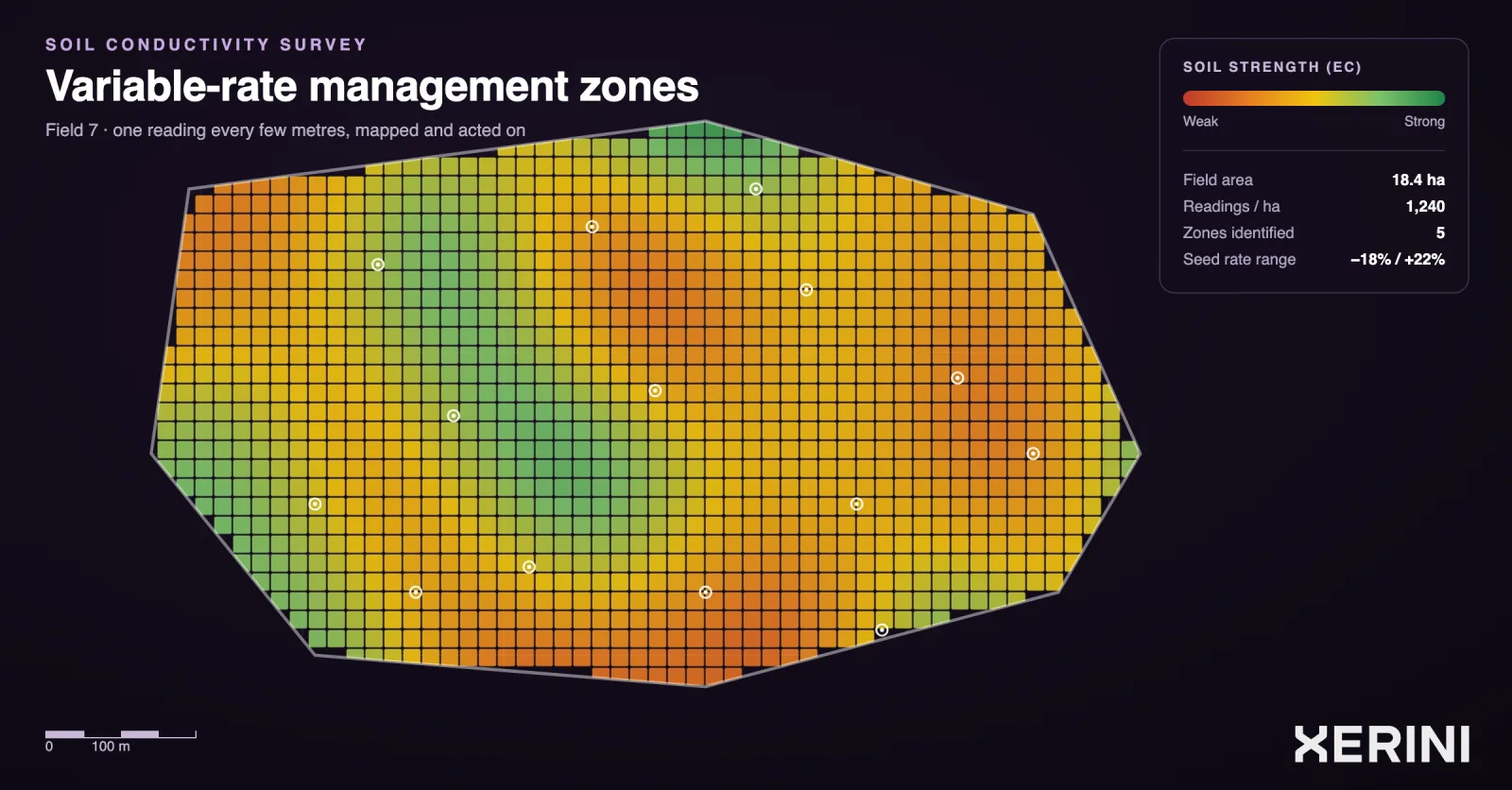
With that map, the farmer can stop averaging and can start targeting. Strong soil is seeded densely and fed to match. Weaker patches are sown more sparingly, so money is not spent on plants that will never thrive there. Fertiliser, water and seed go where they earn their keep and not where they do not.
Why this matters now
The timing is not incidental. Fertiliser prices have lurched around with the energy market, water is under growing pressure, and the weather is less predictable each year. Margins in farming are thin to the point of disappearing, as every series of Clarkson's Farm cheerfully demonstrates. Doing the same thing and hoping for a better year is not a plan.
The wider evidence backs up what van den Borne sees on his own land. Studies of precision techniques across many farms report input savings of roughly eight to twenty per cent and yield gains of a few per cent, alongside lower fuel use, less water and less chemical running off into rivers. One US industry analysis estimated that, without these methods, farmers would need millions of additional acres to grow the same amount of food. Producing more from less is the entire point, and it is measurable.
This is not about fancy-pants AI
Here is the part I find most useful for the rest of us. Some of this does lean on machine learning. Software that reads a satellite image to separate crop from weed, or predicts when a disease will strike from weather and sensor data, is doing pattern recognition that fairly earns the name. What it is not doing is running a giant generative model in a data centre. These are small, well-understood models that run on ordinary hardware, and a good deal of the work around them is plain arithmetic: group the field into zones, work out what each zone needs, set the machine accordingly. A spreadsheet could handle a fair amount of it.
It would be a poor trade to save fertiliser in the field and burn the saving back in a server room.
This distinction is worth noting, because the AI now filling the headlines carries an energy and water problem of its own. The data centres that train and run large language models draw enormous amounts of power, and a great deal of water for cooling. It would be a poor trade to save fertiliser in the field and burn the saving back in a server room. The lesson from the best farms is not "buy the biggest model you can find". It is to measure carefully and then direct your resources to where they do the most good. Most of that is light on compute, and you can get a long way with it before anything heavier is required.
This is not really about farming
Take away the soil and the tractors and the pattern is general. Most organisations treat something as uniform when it is not. Energy gets managed building by building when it varies room by room. Stock is held evenly across sites that sell at very different rates. Sales and support effort is spread across a customer base where a small minority drives most of the value. Maintenance runs to the calendar rather than to the condition of each asset.
The fix is the one the farmers use. Measure at a finer grain than you do now. Map where the variation actually sits. Then move money, people and materials towards the parts that will repay the attention, and away from the parts that will not. Those savings are measurable, and so is the extra output.
You do not need a bigger budget or better luck to do more with less. You need to know your data in detail, and to act on what it tells you.
Helping organisations make that shift, from data collected to decisions made, is a fair description of what we do at Xerini. I will leave it there, because the more interesting point is the one the farmers have already proved. You do not need a bigger budget or better luck to do more with less. You need to know your data in detail, and to act on what it tells you.